Detectors emit. The pipeline decides.
EchoCore AI is not one large multimodal model. Modality-local detectors emit typed observations. A deterministic association step builds candidates you can audit. Two gates then decide what is allowed to leave the pipeline.
Two gates, neither bypassable
Two independent checks sit in the path of every candidate. One bounds confidence to the provenance of the evidence; the other enforces policy at the edges of the pipeline.
Provenance trust gate
Compliance engine
Weak evidence makes a weaker claim
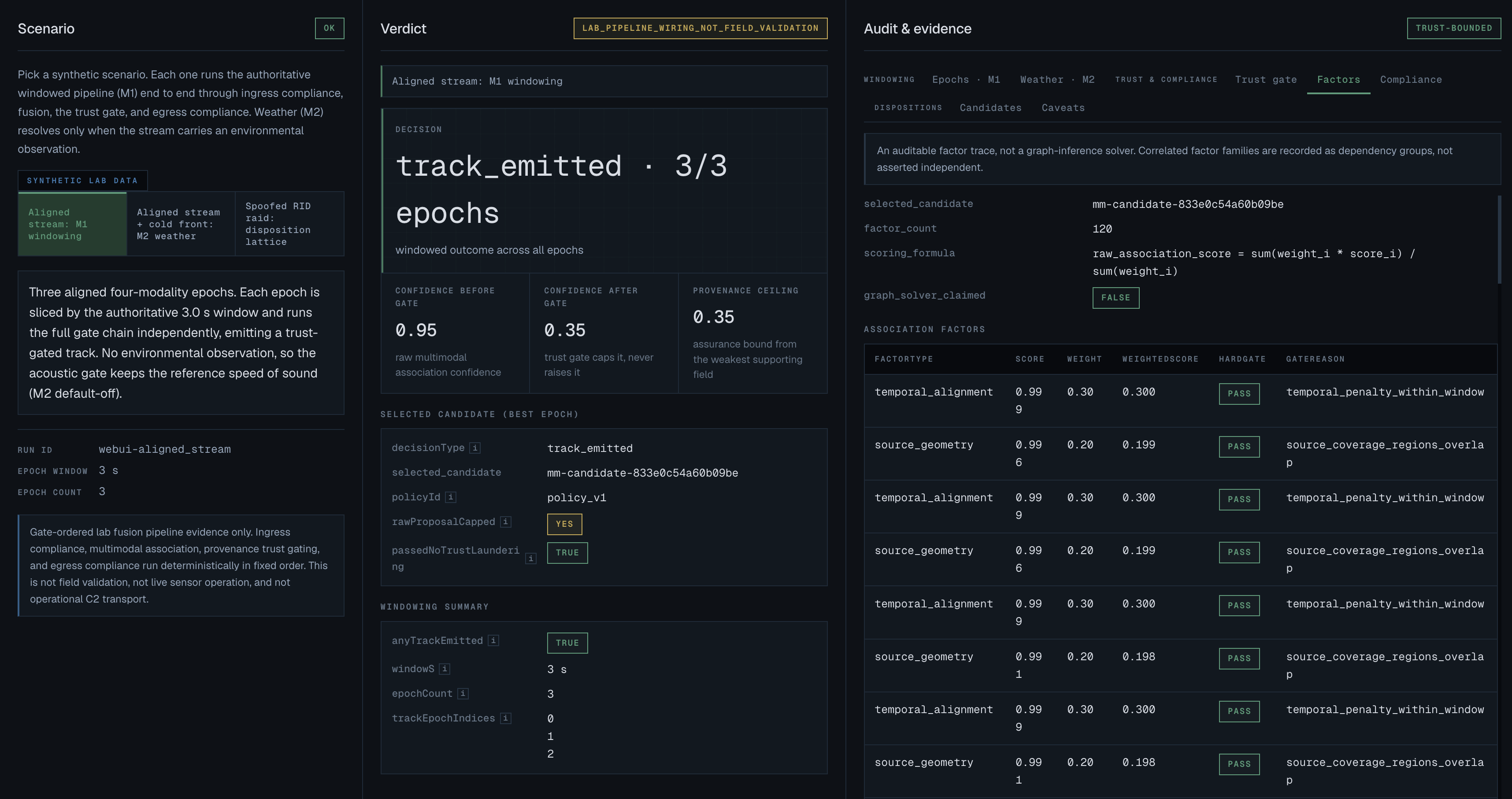
Weak evidence caps the kind of claim a candidate can make, not just its confidence number. Claims are ordered presence < bearing < position < track < identity, and each evidence combination is capped to a maximum claim type and a ceiling.
Concept schematic. The lattice and the ceiling are the architecture, not a fielded measurement.
A scorer that fails the build
EchoCore AI is exercised by Valhalla, a deterministic synthetic testbed, in a golden loop. Valhalla datasets run through the engine unmodified, and a scorer grades the output against simulation ground truth. The scorer surfaced real fusion defects in stream handling, multi-target separation, and spoofer-dominated tracks, and now runs as a CI regression gate on every engine change.
SYNTHETIC. Pipeline behaviour over synthetic data, graded against simulation ground truth across an 8-seed sweep (40,000 synthetic trajectories per threat). Not detector performance. Not field validation.
What runs today, and what it sets up
EchoCore AI is early, and we would rather show the real floor than a painted ceiling. What follows is what actually runs now, and the capability it puts within reach.
172 tests pass across the engine today. Every run is deterministic: the same seed produces byte-identical, hash-chained evidence bundles you can re-run and check yourself.
Two non-bypassable gates, the claim lattice, RID-spoof and GNSS handling: the discipline that keeps weak evidence from becoming a confident track is built and running, not promised.
The architecture is auditable, fail-closed, and fully offline by design, built toward a Protected B accreditation path we intend to earn, not one we hold today.